
Third-party ordering platforms charge Canadian coffee shops 15% to 30% commission on every delivery order. Then comes card processing, GST/HST on those fees, and drink packaging. Put it all together and the real cost is closer to 30% to 40% of each ticket. On a $14 order, that’s about $4.20 to $5.60 gone before you’ve paid for beans, milk, or your coffee’s time.
That hurts a café more than most food businesses. Your tickets are small. Your profit lives in the cup. And your best customers come back every single morning, which is the exact habit the apps want to own.
This guide breaks down coffee shop ordering platform fees on Uber Eats, DoorDash and SkipTheDishes, where the hidden costs sit, and what a year on the apps adds up to for one Canadian location.
Quick Answer
- What it costs: Most Canadian cafés pay 15% to 30% commission on delivery orders, plus processing and tax on the fees. The true cost often lands between 30% and 40% of the order.
- Who it hurts most: Coffee shops with small average orders, lots of pickup traffic, and loyal morning regulars.
- What to do about it: Keep the apps for finding new customers. Move pickup and repeat orders to your own commission-free ordering channel.
TL;DR
- Delivery apps charge Canadian coffee shops 15% to 30% commission on each order.
- Add processing, GST/HST on the fees and packaging, and you lose 30% to 40% of every ticket.
- Keep the apps for finding new customers, and move pickup and repeat orders to your own commission-free ordering.
Key Points
- Uber Eats and DoorDash charge 15%, 25% or 30% on delivery, based on your plan. SkipTheDishes is often near 25%.
- B.C. is the only province with a permanent cap. Apps there can charge no more than 20% in total.
- Small coffee orders lose more to packaging and fixed costs. A $6 latte that leaves you $4.80 at the counter leaves about $2.23 through an app.
- The hidden costs add up fast: GST/HST on fees, promos you pay for, refunds taken from your payout, and paid placement.
- At 25 app orders a day, one café pays about $37,800 a year in fees.
- Pickup orders still carry commission, even though the customer walks into your café.
- Moving just 10 daily orders to direct ordering can leave a café about $10,500 ahead in year one, after plan and setup costs.
What Coffee Shop Ordering Platform Fees Look Like in Canada in 2026
Every big delivery app in Canada sells plans in tiers. A lower commission gets you less visibility. A higher one puts your café on the home screen and in front of subscription members.
Here’s what the usual setup looks like for a Canadian café. Rates change by city, contract and order volume, so always check your own partner agreement.
| Platform | Delivery commission | How the plans work | Pickup orders |
| Uber Eats | 15% to 30% | Lite 15%, Plus 25%, Premium 30% | Lower rate, often around 6% to 7% |
| DoorDash | 15% to 30% | Basic 15%, Plus 25%, Premier 30% | Lower rate than delivery |
| SkipTheDishes | 20% to 30% | Often near 25%, set by your contract | Lower rate than delivery |
The cheap tier has a catch. On Lite or Basic, your café shows up less often, your delivery area is smaller, and you’re left out of most promoted spots. Plenty of owners start there and get pushed up to 25% once they see how few orders come in.
Commission isn’t the only line, either. Each order also carries a card processing fee, usually somewhere around 2.5% to 3%. And orders from Uber One or DashPass members can come with extra costs on some plans. In most cases, you only reach those members on the higher tiers anyway.
British Columbia’s 20% Cap
B.C. is the only province with a permanent limit on what delivery apps can charge restaurants. Under the Food Delivery Service Fee Act, in force since January 1, 2023, apps can take no more than 15% for delivery plus 5% for other fees. That’s 20% in total.
Ontario, Quebec, Nova Scotia and Saskatchewan all had short-term caps during the pandemic. None of them kept one. So if you run a café in Calgary or Toronto, 30% is still on the table. If you’re in B.C., the cap helps, but 20% of a small coffee order is still a big bite. Cafés looking at an online ordering system in Vancouver usually do the math on that 20% first.
Why Percentage-Based Fees Hit Coffee Shops Harder Than Restaurants
A percentage sounds fair. Big order, big fee. Small order, small fee. But a coffee shop doesn’t run like a steakhouse, and the fixed costs tell the story.
Think about packaging. A $10 order with two drinks needs two cups, two lids, sleeves, a carrier, a bag and a seal sticker. That can easily run $0.90 to $1.20. It’s roughly 10% of the order before the app takes anything. A $60 dinner order might use $2.50 in containers, which is about 4%.
Labour works the same way. Bagging a drink order takes about the same minute whether it’s $8 or $40.
Here’s a single latte, start to finish. Say it sells for $6 and your milk, espresso and syrup cost $1.20. At the counter, you keep about $4.80 before card fees. Through an app at 30% commission, you lose $1.80 to the platform, about $0.17 to processing, and around $0.60 to the cup, lid, sleeve and bag. You’re left with about $2.23. That’s less than half, and you still haven’t paid for rent or wages.
Then there’s timing. Most coffee orders land in the morning, right when your line is already out the door. Two or three tablets start beeping. A coffee has to stop, read the ticket, make the drinks and bag them.
If the driver runs late, the latte foam drops and the iced drinks melt. The customer doesn’t blame the driver. They blame your café, and they tell the app.
The Coffee Shop Ordering Platform Fees Nobody Quotes You
The commission is the number on the sign-up page. These are the costs that show up later, buried in your weekly statement.
GST/HST on the Commission
Delivery app fees count as a service, so GST or HST gets charged on them. For an Ontario café paying 13% HST, a $3.50 commission comes with another $0.46 in tax per order.
If you’re registered for GST/HST, you can usually claim that back as an input tax credit. But you pay it first, every week, and it ties up cash. If you’re a small supplier under $30,000 a year in taxable sales and not registered, you can’t claim it at all. It’s worth a quick chat with your accountant.
Promos You Pay For
“$5 off your order” looks like the app is being generous. Usually, it’s you.
Take a $15 order with a $5 discount you agreed to fund. The order drops to $10. Then 25% commission comes off that, which is $2.50. You’re left with $7.50 for food and drinks that sell for $15 at your counter. Apps often push these promos because they help your ranking, so saying no can cost you visibility.
Refunds and Chargebacks
A cold latte. A missing muffin. Oat milk instead of almond. The customer reports it in the app, the app gives a refund, and that refund often comes out of your payout.
You can dispute it. But it takes time, and drink complaints are hard to prove after the fact. Iced drinks are the worst for this, since nobody can show you what the cup looked like 25 minutes after it left your counter.
Paying to Be Seen
Sponsored listings and in-app ads cost extra. Some Canadian operators report paying roughly $50 to $200 a week for featured placement on SkipTheDishes. Over a year, that’s $2,600 to $10,400, on top of commission.
Menu Markups That Put Off Regulars
To cover the fees, a lot of cafés raise their app prices by 15% to 25%. Your $6.25 latte becomes $7.50 on Uber Eats.
Then the customer adds a service fee, a delivery fee and a tip. That $6.25 drink can cost them double. Most people don’t blame the app for that. They decide your café is expensive.
What a Year on Delivery Apps Costs a Single-Location Canadian Café
Small fees feel harmless one order at a time. Over a year, they turn into a salary.
Here’s what it looks like for one location. These numbers assume a $14 average order, a 30% effective rate (commission plus processing plus tax on fees), and 360 open days a year.
| Daily app orders | Yearly sales through apps | Yearly cost at 30% |
| 10 | $50,400 | $15,120 |
| 25 | $126,000 | $37,800 |
| 50 | $252,000 | $75,600 |
At 25 orders a day, you’re handing over $37,800 a year. That’s roughly what two part-time coffees earn in a year at $18 an hour.
Not all of that is money you’d save by leaving the apps. Some of those orders only exist because a stranger found you on Uber Eats. And if you deliver yourself, drivers aren’t free. But a big share of it comes from customers who already know you, and that’s the part worth taking back.
The Cost You Can’t See on the Statement: Losing Your Daily Regulars
A coffee customer isn’t a once-a-month order. They’re a daily one.
Picture a regular who buys a $6 latte five days a week. That’s $1,560 a year from one person. If they order through an app at 25% commission, the app keeps $390 of it. Every year.
You also lose the person. When someone orders through an app, the platform keeps their name, email, phone number and full order history. You might see a first name on the ticket. You can’t send them a free pastry on their birthday or tell them your fall drinks just landed.
Uber One and DashPass make it worse. Those programs reward people for ordering through the app, not through you. Lower delivery fees and member deals train your regulars to open Uber Eats first. And the next time they open it, the app shows them three other cafés with a promo running. Your own punch card never gets a look.
Why Pickup and Order-Ahead Should Never Carry a Commission
Coffee is a pickup business. Most people grab their cup on the way to work, the gym or school drop-off. Order-ahead is how most cafés use online ordering.
So think about a pickup order through an app. No driver. The customer walks into your café, the same as always. You still pay around 6% on Uber Eats for that order, plus processing. On a $14 order, that’s $0.84 in commission for a customer who was already coming in.
Fifteen pickup orders a day at that rate adds up to $4,536 a year. That’s money paid to an app for a walk-in.
Direct order-ahead fixes this. A customer taps your own coffee shop ordering app, pays ahead, walks in and grabs their cup. No commission. You get their name, their usual order and a way to reach them. A QR code ordering system at the counter and on your cups makes it easy for walk-ins to make the switch.
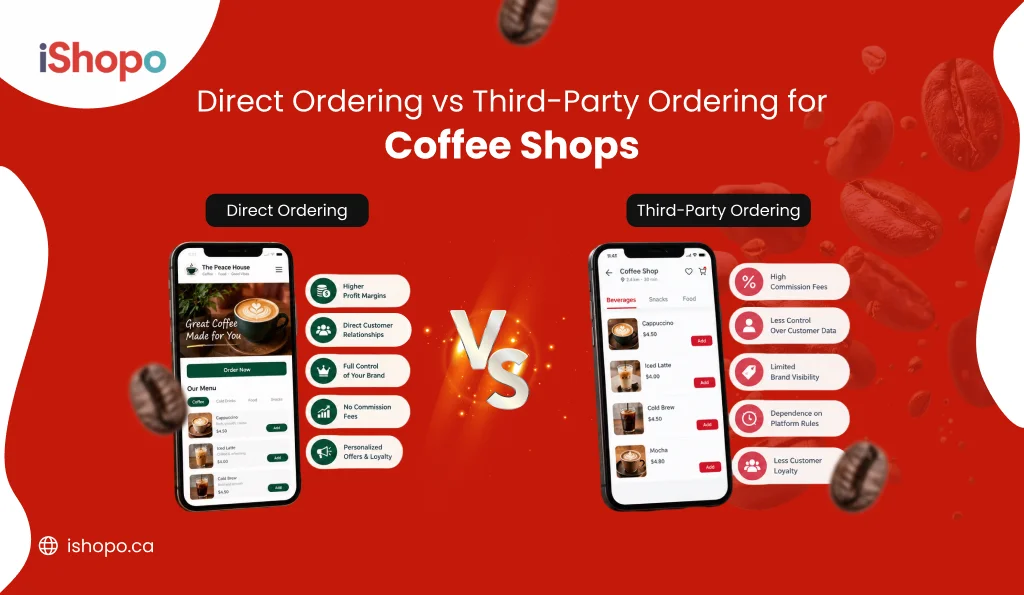
Commission-Free Ordering vs Third-Party Apps: A Coffee Shop Fee Comparison
Here’s how the two models stack up for one café location.
| Third-party apps | iShopo direct ordering | |
| Commission | 15% to 30% on delivery, lower on pickup | $0 |
| Monthly cost | None | From $99 per location |
| Setup | Varies by app | One-time $1,000 |
| Customer data | Kept by the platform | Yours |
| Loyalty program | Uber One or DashPass, not yours | Your own points, rewards and gift cards (Growth plan and up) |
| Menu prices | Often marked up to cover fees | Your counter prices |
| Finding new customers | Strong, built-in audience | You bring the traffic |
The apps do one thing better, and it’s fair to say so. They’re good at getting a stranger to try you. A direct ordering system won’t create demand on its own. You still need to point people to it with QR codes, in-bag cards, your Google profile and your social pages. Card processing fees also still apply on direct orders, the same as any card sale at your counter.
You can see what each plan includes on the iShopo pricing page.
How iShopo Brings Coffee Shop Ordering Platform Fees Down to Zero Commission
iShopo is a commission-free online ordering platform for Canadian restaurants, cafés and coffee shops that helps owners take direct pickup and delivery orders under their own brand. Best for: single-location cafés, small coffee chains, and any shop that wants its regulars ordering direct instead of through an app.
The smart move isn’t to quit the apps overnight. It’s to use them for what they’re good at, which is new customers, and stop paying them for the ones you already have.
Here’s how that usually works in a café:
- Put a card in every app bag. Add a short note with a QR code: “Order direct next time and get a free cookie.” That turns an app customer into your customer.
- Give regulars order-ahead under your name. Your menu, your prices, your logo, with every order going straight into Square, Toast, Clover or Lightspeed.
- Reward them for coming back. Loyalty points, digital gift cards and repeat-order offers give people a reason to skip the app.
- Add a branded app when you’re ready. Busy shops with a strong morning crowd often move up to branded mobile apps for iOS and Android.
Plans are flat per location. Basic Web Ordering is $99 a month for pickup and QR ordering. Growth & Marketing is $299 a month and adds loyalty, gift cards and delivery integration. App Commerce is $499 a month and adds your own iOS and Android apps. There’s a one-time $1,000 setup fee.
Here’s what that looks like in real numbers. Say your café takes 25 app orders a day and you move just 10 of them to direct ordering. At a $14 average and a 30% effective rate, that’s $15,120 a year you stop paying the apps. The Growth plan costs $3,588 a year plus the $1,000 setup. You’d still be about $10,500 ahead in year one. Cafés that also sell pastries and lunch can read more about our cafe online ordering system.
Conclusion
Third-party apps cost Canadian coffee shops far more than the commission rate on the sign-up page. Add tax on the fees, promos, refunds, ads and the regulars you slowly lose, and the real cost is closer to a third of every order.
Keep the apps for discovery. Take back the customers who already love your coffee. Book a free demo with iShopo and see how much of your app spend you could keep, starting with a 14-day free trial and no credit card needed.
FAQs
Does SkipTheDishes Charge Less for Pickup?
Yes. Pickup orders on SkipTheDishes usually carry a lower commission than delivery orders, since no driver is involved. The exact rate depends on your partner agreement, so check your contract. Even a lower rate still means paying a fee for a customer who walks into your café.
Is GST/HST Charged on Delivery App Commissions?
Yes. Delivery app fees are a taxable service in Canada, so GST or HST is added on top of the commission. If you’re registered for GST/HST, you can usually claim it back as an input tax credit. Small suppliers who aren’t registered can’t, so it becomes a straight cost.
Can I Charge Higher Prices on Uber Eats?
Yes. Uber Eats, DoorDash and SkipTheDishes let you set separate menu prices for their apps. Many cafés mark up 15% to 25% to cover fees. The risk is that regulars notice the gap and start to see your café as overpriced.
What Is the Cheapest Way for a Coffee Shop to Take Online Orders?
A commission-free direct ordering system is usually the cheapest option once you have steady orders. You pay a flat monthly fee instead of a share of every sale. For a café doing 10 or more online orders a day, the savings often cover the monthly cost within the first few weeks.
Should My Coffee Shop Quit Delivery Apps Completely?
Not usually. The apps are still good at bringing in people who’ve never heard of you. The better plan is to keep a listing for discovery and move pickup orders and repeat customers to your own ordering channel, where you keep the full sale.